A parent should read this comparison because choosing an early childhood program is often overwhelming, and this breakdown gives them immediate clarity to match their child’s specific personality with the right learning environment.
-
Demystifies Educational Jargon: Translates complex teaching terms like “self-directed learning” or “holistic rhythm” into clear, practical daily classroom experiences.
-
Matches Philosophy to Child Temperament: Helps parents identify whether their child will thrive best in structured independence (Montessori), social group exploration (Play-Based), or imaginative, routine-focused settings (Waldorf).
-
Sets Clear Academic Expectations: Clarifies when and how core skills—such as reading, phonics, motor control, and social collaboration—are introduced across different approaches.
-
Eliminates Search Fatigue: Replaces hours of conflicting online research with a quick, side-by-side reference they can evaluate in under two minutes.
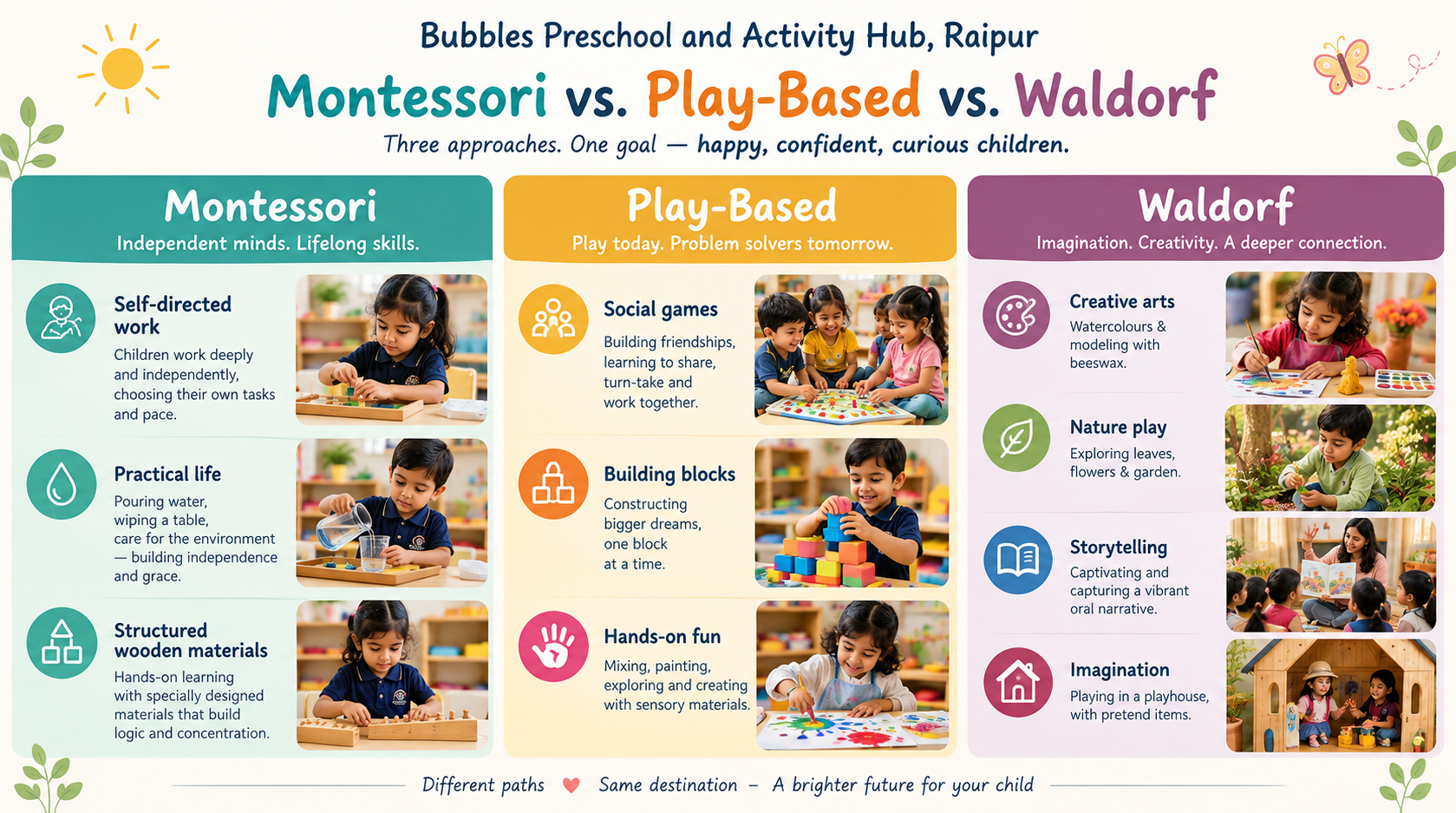
| Feature | Montessori Self-Directed Learning |
Play-Based Social & Experiential |
Waldorf Creative & Holistic |
|---|---|---|---|
| Core Philosophy | Independence, practical life skills, and child-led activity choosing. | Social interaction, curiosity, and learning naturally through play. | Imagination, artistic expression, and predictable daily rhythms. |
| Classroom Environment | Orderly, child-sized furniture with organized, accessible work stations. | Vibrant, activity-focused spaces with sensory bins, blocks, and play corners. | Warm, homelike atmosphere using natural materials, wood, and soft lighting. |
| Teacher’s Role | Guide & Observer: Shows children how to use tools, then steps back. | Facilitator: Joins in play to introduce concepts and social skills. | Role Model: Leads through storytelling, arts, rhythm, and songs. |
| Toys & Materials | Self-correcting, structured wooden materials & real-life practical tools. | Diverse toys, puzzles, building blocks, and interactive pretend-play setups. | Unstructured natural objects (wood, silk, wool) that stimulate creative imagination. |
| Academic Approach | Introduced early (phonics, math, practical skills) through tactile materials. | Integrated organically into games, storytelling, and group activities. | Formal academics deferred until age 6-7; focuses first on arts, movement, & stories. |
Here are some videos for a parent to go through to gain better understanding
What style of pedagogy is being followed at Bubbles Preschool and Activity Hub?
At Bubbles Preschool and Activity Hub in Raipur (an initiative backed by Brighton International School) follows a child-centric, play-based, and experiential early education methodology designed around individual learning styles. So in a way possibly best of all the worlds and customised to what is relevant and today’s demand. If one has to characterise;
- Adaptive & Child-Centric Learning
- Multi-Sensory Tailoring: Lessons are adapted to accommodate visual, auditory, and kinesthetic learning styles rather than forcing a single rigid instruction model.
- Flexible Pace: Teachers modify and retry methods—using movement, games, and storytelling—until every child understands a concept without academic stress.
- Experiential & Activity-Based Pedagogy
- Practical Exploration: Concepts are taught through hands-on activities, such as using staircases and block towers to teach ascending/descending numbers instead of relying solely on worksheets.
- Sensory & Skill Play: Daily routines integrate art and craft, music, storytelling, and sensory bins to build fine motor, cognitive, and social skills.
- Structured Early Childhood Framework
- Age Programs: Offers tailored programs covering Playgroup, Nursery, KG I, and KG II for children aged 1.5 to 6 years.
- Brighton DNA: Powered by the early years framework and curriculum model of Brighton International School.